

The 100-Foot Root
August 16, 2026
When Doing Everything Right Still Isn’t Enough
September 13, 2026The 100-Foot Root
August 16, 2026When Doing Everything Right Still Isn’t Enough
September 13, 2026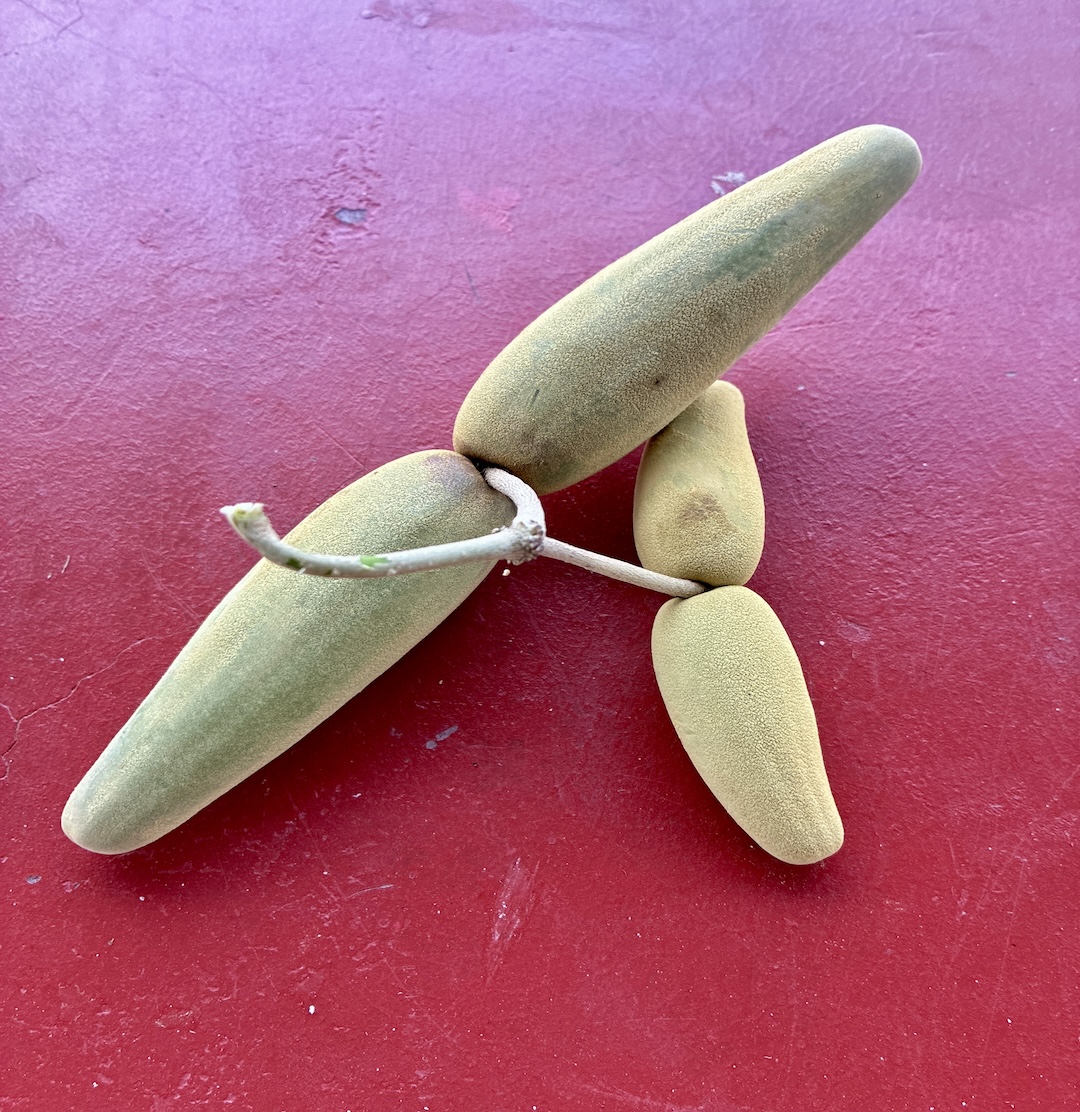
The Caterpillar That Moved Toward the Poison
In our farm this weekend, I found four velvety, finger-like pods twisted around a curling stem — pale olive-tan, suede-soft, almost sculpted. Our caretaker, who reads that land better than most agronomists, didn't recognise it. I turned to AI, and after a few exchanges we landed on Dregea volubilis — a twining climber, cousin to milkweed.
The plant itself was interesting. What stopped me was who eats it.
Dregea's latex carries cardiac glycosides — compounds strong enough to stop a vertebrate heart, the plant's answer to being grazed into extinction. Most animals learn to avoid it, once, decisively. But the caterpillar of the Blue Tiger butterfly doesn't avoid it. It eats the leaves anyway. Across an immense evolutionary timescale, it developed a modified version of the very target the toxin was built to jam — not a workaround, but a direct rewiring of the mechanism the plant uses to kill. It also stores the toxin just under its own skin, unchanged, carrying the plant's weapon in its body even after it turns into a butterfly.
The caterpillar didn't route around the threat. It went straight at it, absorbed it completely, and started wearing it. The poison built to stop it became the armour that protects it — carried openly, boldly striped, because a predator like birds that learns this lesson once tends to remember.
Our instinct, in business and in life, is almost always to keep the dangerous thing at a distance — a wall, a policy, an avoided conversation, a diversification away from risk. That's not wrong, exactly. But avoidance has a ceiling. We can only wall off so much before the wall becomes the whole strategy.
The people and teams I trust most under real pressure choose the opposite direction. Hard feedback, a market turned against them, a competitor they can't out-manoeuvre — they don't wall it off, and they don't just endure it either. They go toward it deliberately, study exactly how it works, and let it change something structural in how they operate. What comes out the other side isn't a team that survived the threat. It's one that's harder to move because of it.
Worth being honest here: the caterpillar had millions of years and countless generations to work out that rewiring. We don't get evolutionary time in a career or a business cycle — we get one quarter, one hard year, one crisis to handle now. This isn't a claim that absorbing a threat is quick or easy for us. It's a reminder that the direction is worth considering deliberately even on a compressed timeline — leaning toward what threatens you, a little at a time, still builds something sturdier than leaning away, even if none of us gets it as right as the caterpillar did.
Avoidance keeps us safe from what we can see coming. Absorption is what makes us dangerous to what comes next.